
Poster
Association for the Scientific Study of Consciousness
ASSC8 Antwerp, Belgium, 25-28 June 2004
Dreams are a form of consciousness
(Searle 1997 p 3)
“it is not like anything to dream,
although it is like something to have dreamed.”
(Dennett 1976 p 138)
“Are we aware of what happens in our dreams?
Of course. Therefore dreaming is a conscious experience.”
(Hobson 1999 p 209)
2 conflicting facts
1. Dreams sometimes seem to be concocted at the moment of waking up.
2. There is evidence that dream events occur in real time
(e.g. incorporation studies, lucid dreamers signaling from times dreams)
Can the two be reconciled?
No Cartesian Materialism – this is the natural assumption. Dreams are experiences happening during sleep.
There must be an answer to the question “What is he dreaming about now?”
On this view 1. and 2. conflict.
Yes To avoid the conflict we must give up CM and the idea that there is an answer to the question
“What is he dreaming about now?”
Here is one way ……
The gist
Are dreams experiences happening during sleep?
When someone is asleep and dreaming, is there an answer to the question
“What is happening in the dream now?”
Conventional theories say Yes
I say No.
The illustration (simplified from the actual poster) shows how the theory works. During dreaming the brain sustains numerous different trains of thought, and perception. None of these is “in consciousness”; none of these is “what is happening in the dream”. Rather they are all possible threads that may be called on later, in an indefinite number of possible combinations. When the sleeper awakes, a dream is concocted, backwards, by selecting any one of the possible multiple threads that might have been selected. The illustration shows just three possible dreams that might have been concocted from the scraps of memory that remained.
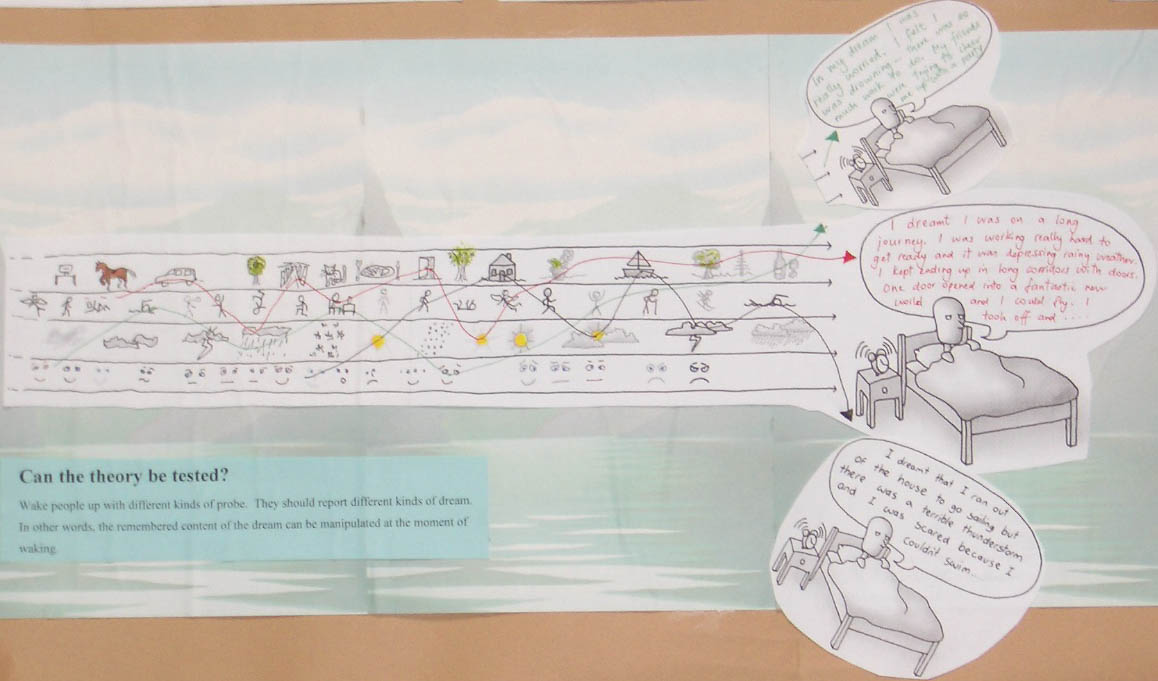
Dreams are commonly described as experiences or altered states of consciousness, but there are problems with both these characterisations. There is also conflicting evidence suggesting both that dreams happen in real time, and that they can be concocted at the moment of waking up. This poster describes a theory that allows both of these to be true. The retro-selective theory of dreaming avoids the danger of treating dreams as experiences that happen “in consciousness”, or in a Cartesian theatre.
During REM sleep numerous brain processes go on in parallel, with none being either “in” or “out” of consciousness. On waking up, any number of stories can be concocted by selecting one of a vast number of possible threads through the multiple scraps of memory that remain. The chosen story fits the timing (e.g. of incorporated external events) but it is only one of many such stories that might have been selected. There is no actual dream; no story that really happened “in consciousness”.
References
Blackmore, S. (2003) Consciousness: An Introduction. London, Hodder & Stoughton; New York, Oxford University Press
Dennett, D.C. (1976) Are dreams experiences? Philosophical Review, 73, 151-171 also in D.C. Dennett Brainstorms Penguin 1978, 129-148
Dennett, D.C. (1991) Consciousness Explained. Boston, MA, and London; Little, Brown and Co.
Gackenbach, J., and LaBerge, S. (Eds) (1988). Conscious Mind, Sleeping Brain: Perspectives on Lucid Dreaming. New York: Plenum.
Hobson, J.A. (1999) Dreaming as Delirium: How the Brain Goes Out of its Mind. Cambridge, MA., MIT Press
Searle, J. (1997) The Mystery of Consciousness. N.Y. New York Review of Books